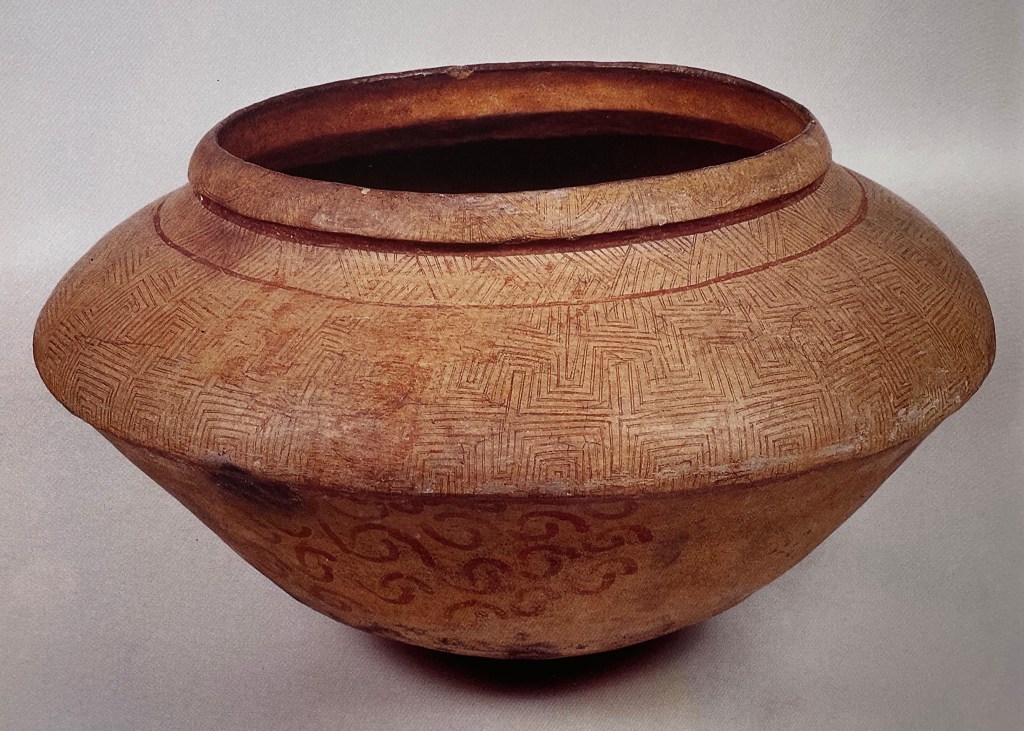
In the northeastern coastal regions that the Dutch (and the Portuguese) inhabited, indigenous peoples speaking Tupi-Guarani languages predominated and came into contact with the European colonizers. They had their own vibrant material culture, much of which has been lost to time. It is known from reports and archaeological excavations that the Tupi-Guarani made pots and vases of ceramics for practical and ceremonial use. These ceramics, which could be use to brew, cook, or store food, could then be repurposed as funerary urns. Such an example is featured in this post.
The urn is painted with intricate geometric patterns thatare separated into discrete categories using the natural shape of the urn. The artisan of this object used a red paint, a color that was quite often employed by the Tupi-Guarani. The complexity of the design and care of the lines reveals the maker’s skill and close attention to detail. patterns were not merely decorative, but also carried particular associations, which are still being studied and identified.
Very little archaeological material survives from the Quilombo dos Palmares itself. What has been found primarily consists of small shards and broken pieces of pottery. Images of the archaeological findings have not yet been fully released. Turning to ceramics produced by indigenous groups of Brazil made prior to or during the initial period of colonial occupation allows us to visualize what some of these ceramics may have looked like. Indigenous people figured among the multicultural society of the quilombo and they likely would have participated in creating the ceramics that have been found. Using this urn, we can envision what types of pottery would have been made and handled on a daily basis in the community and put such examples to use in contrast to the artistic production of the Dutch colonizers to open a window into an art history that includes such a significant fugitive community.
Reference: Nelson Aguilar, Negro de corpo e alma = black in body and soul (São Paulo: Fundação Bienal de São Paulo; Associação Brasil 500 Anos Artes Visuais, 2000), 176-177.
 QUILOMBO DOS PALMARES AND SEVENTEENTH-CENTURY BRAZIL