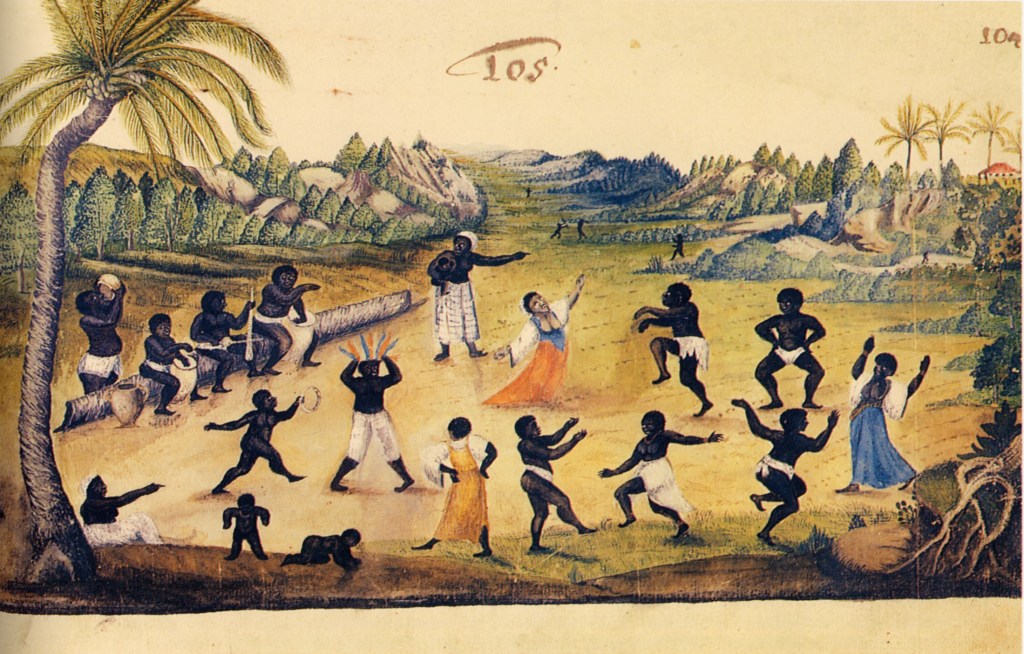
The German merchant, illustrator, and eventual governor of the Dutch Cape Colony made his way to Brazil in 1634 as a soldier with the Dutch West India Company. After the arrival of the Johan Maurits van Nassau-Siegen, Wagener was drawn into the new governor’s employ. During this time, he began a journal that documented not only his observations of Brazil and its people, but also included watercolor drawings of scenes he witnessed throughout his time and travels in the Dutch colony. His drawings would not have been viewed during the seventeenth century by many outside of Wagener’s own circle, but they do record an intimate glance into the European colonizing elite’s perception of Africans and indigenous peoples. The tone of his journal, referred to as the Thierbuch, is harsh and sharply racist and leaves no questions as to the sort of punishing and inhuman treatment from which the Palmarinos fled.
Wagener also recorded scenes he saw of enslaved Africans who were forced to work the sugar plantations. This image contrasts from some of his others of Africans in showing them not at work, but at leisure, (seemingly) out of the eye of European overseers. While it cannot be known to what extent practices in the Palmares corresponded to Africans in slavery, it is likely that such rituals and dances were also performed in the quilombo. This image provides a basis from which to imagine what such practices may have looked like. It also allows us to question the relationship between art made by European colonials and the quilombo. What is the purpose of this image for Wagener? How are the Africans in this image being characterized and to what extent did or did not the existence of Palmares undercut this narrative? What is the significance of a multicultural community such as Palmares in a colony whose cultural production nearly always depicts only one race in isolation?
 QUILOMBO DOS PALMARES AND SEVENTEENTH-CENTURY BRAZIL