The Historia Naturalis Brasiliae, published in 1648, compiles 12 books total, 4 by Willem Piso (De Medicina Brasiliensi) and 8 by Georg Marcgraf (Historia Rerum Brasiliensi). Both Piso and Marcgraf came to Brazil in 1637 under the patronage of the governor Johan Maurits van Nassau-Siegen and carried out their explorations of the region to make scientific discoveries for his court until 1644. Piso’s writings describe the medical aspects of Brazil and delineate the diseases native to the land. His text includes his observations of the native people and their customs in experiencing and healing illnesses, which serve as an important source for any interested in the undercommons of Brazil, despite the fact that Piso characterized the indigenous population as barbarous. Marcgraf’s contributions largely address the natural history of Brazil and describe the plants, animals, insects, and geography of the land. Johannes de Laet, a Dutch geographer and director of the Dutch West India Company, also played a part in the production of this text, providing observations and writing the preface.
As a whole, the book contains 446 woodcut illustrations accompanying the text, most of them likely done in situ by Marcgraf himself. These images are an invaluable aid in reconstructing the naturalia present in the land at the time of the Quilombo dos Palmares.
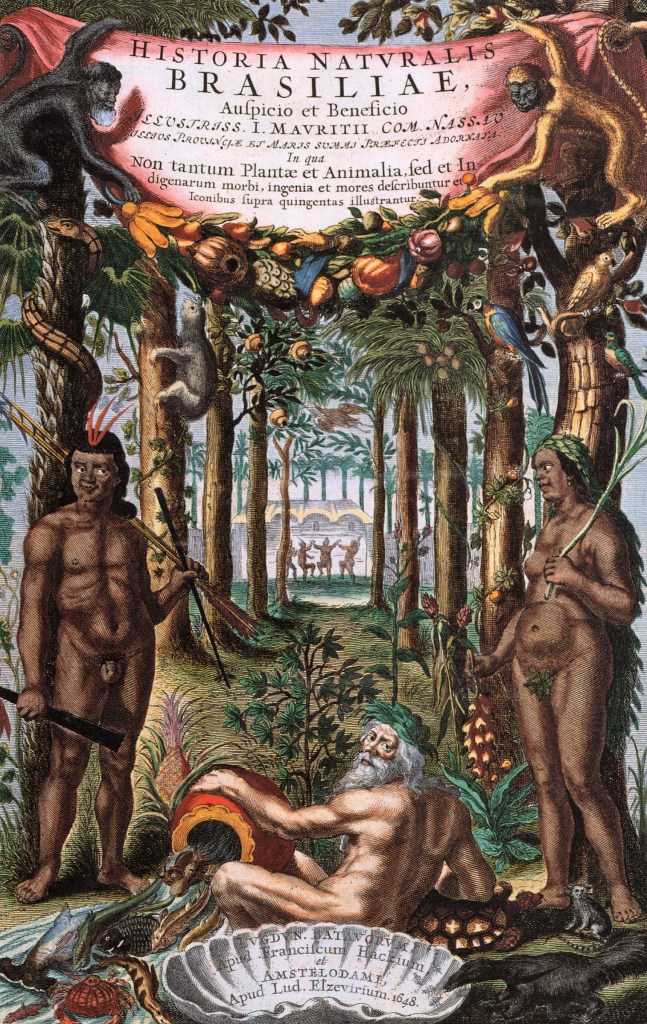
The frontispiece depicted here illustrates a Brazilian Adam and Eve set amidst a flourishing landscape filled with fruits and animals. The image establishes the character of the texts to follow and frame Dutch Brazil in a Christian worldview.
A digital copy of the original text can be found here: https://archive.org/details/marcgrave/page/n3/mode/2up.
Further reading: Safier, Neil. “Beyond Brazilian Nature: The Editorial Itineraries of Marcgraf and Piso’s Historia Naturalis Brasiliae.” In The Legacy of Dutch Brazil, edited by Michiel van Groesen, 168-186. Cambridge: Cambridge University Press, 2014.
 QUILOMBO DOS PALMARES AND SEVENTEENTH-CENTURY BRAZIL