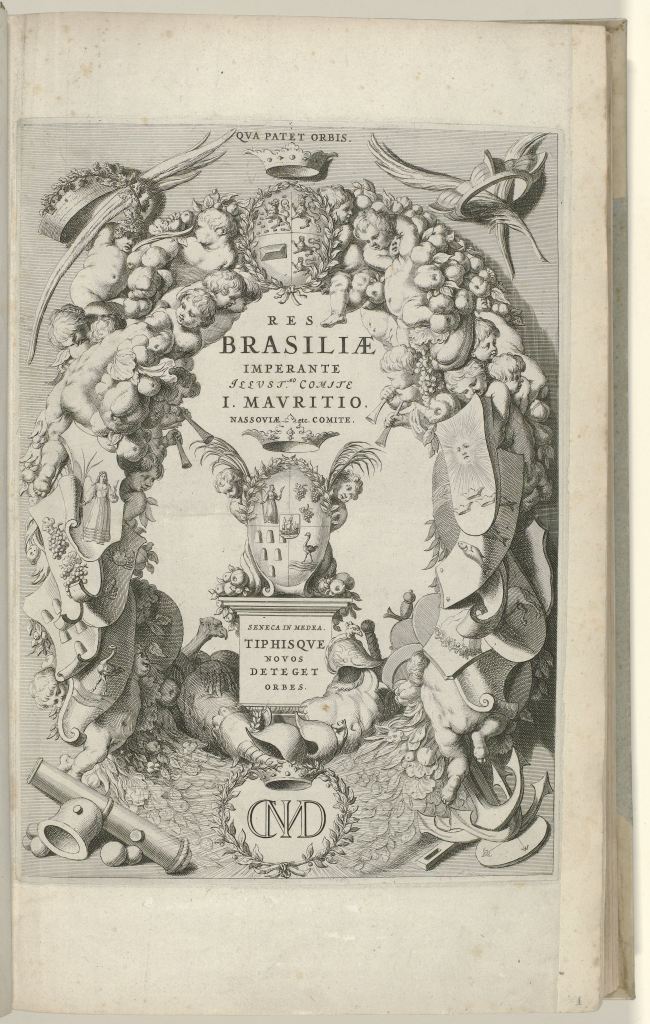
Caspar Barlaeus (1584-1648), also known as Caspar van Baerle, was a Dutch humanist and historian, who provides the primary source for an account of Dutch Brazil in his Rerum per octennium in Brasilia et alibi nuper gestarum, sub praefectura illustrissimi Comiti I. Mauritii…Historia (History of the Recent Activities in Brazil and Elsewhere over a Period of Eight Years under the Governorship of Count Johan Maurits), published in 1647. His history derives from sources provided by Johan Maurits von Nassau-Siegen, the governor of Brazil from 1637 to 1643, who likely commissioned the text’s creation.1 Written in Latin, the text valorizes Maurits’s stewardry of Brazil and his strength as a military and political leader, despite the many troubles and hardships that beset the Dutch colony. The Historia provides he primary source for an account of this eight-year period in Brazil’s history; Maurits’s governorship is especially significant for art history as he commissioned a number of different images of the environment and peoples of Brazil. Barlaeus’s history itself was illustrated with engravings that depicted city views, battles, and maps of Brazil, often accented with figurative scenes of native and Afro-Brazilians.
Bartholomeus Lintz
Also included in Barlaeus’s history are two instances in which the Dutch sought out Palmares in the 1640s. The first was conducted by Bartholomeus Lintz in 1640. The Dutch sent Lintz on this scouting expedition out of fear of the growing power and numbers of Palmares following the upheaval of their conquest of northeastern Brazil in 1630. Lintz’s description of Palmares is the first occasion in which the fugitive community appears in the official historical record. Barlaeus describes the makeup of Palmares, which consisted of several smaller villages rather than one large city. Barlaeus writes:
“It was also decided that the settlement known as Palmares must be destroyed. A band of thieves and fugitive slaves lived there and formed a society of criminals and bandits who raided the Alagoas, where they devastated the cultivated fields. The Palmares are villages and settlements of Negroes. There are two, Greater Palmares and Little Palmares. They are hidden in the woods on the bank of the Gungouí River, which runs into the famous Paraíba River, about twenty miles form the Alagoas and about six miles north of Paraíba. It is said that there are six thousand inhabitants, living in houses close together made of simple materials such as straw and branches, behind which are fields of palm trees. They follow the religion and governmental system of the Portuguese; the priests preside over religious affairs, and the judges over the rules of government. If one of their slaves brings in a Negro captured elsewhere, the former is set free, but whoever joins this society of his own free will is considered a free man. The products of the land consist of the fruits fo the palm trees, beans, potatoes, manioc, maize and sugarcane. The rivers in northern Alagoas provide them with large quantities of fish. They love the meat of wild animals because they lack domesticated cattle. Maize is planted and harvested twice a year, and when the harvest is finished they will spend two weeks resting and indulging in unbridled pleasure. One reaches the Palmares by following the North Alagoas River. A certain Bartholomeus LIntz, who had lived among them and knew their location and their habits, was to serve as a guide for their present expedition and thereby betray his former companions.
“The Greater Palmares are situated at the foot of Mount Behé, thirty miles form Santo Amaro. Almost five thousand Negroes live there in settlements in the valleys. They live in houses scattered over the area, built close to an opening into the woods. The house has a rear exit that leads to a path constructed of tree trunks across which they can flee in case of danger and find a hiding place. They spend the day hunting, and when they return in the evening it does not trouble them that some have not returned. First they post guards, and then spend the time dancing until midnight, beating the ground with so much noise that it can be heard from far away. The rest of the night is spent sleeping until nine or ten in the morning.
“The road to the Palmares starts in the Alagoas. A certian Magalhâes, who lived in the Alagoas, was assigned as a guide to lead the expedition, which was planned to start in September at the earliest because of the lack of drinking water in the dry season. The Dutch hd estimated that this population could be brought under their control with a force of three hundred soldiers armed with muskets and flintlock, one hundred mulattoes, and seven hundred Brazilians armed with their own weapons. These weapons consisted of axes, hoes, double-sided axes, and cutters to remove undergrowth and clear a path, together with whatever weapons they had captured during battles with us. The Brazilians were promised rewards as the only way to get them to face danger. Count Johan Maurits and the Supreme Council had planned this expedition, but it was canceled because of the rebellion in São Tomé and the preparations for Brouwer’s journey to Chile.” – Caspar van Baerle, The History of Brazil under the Governorship of Count Johan Maurits of Nassau, 1636-1644, trans. Blanche T. van Berckel-Ebeling Koning (Gainesville: University Press of Florida, 2011), 236-237.
Rudolph Baro
The second mention of Palmares references the campaign by Rudolph Baro in 1643. Baro was a Tapuya interpreter and emissary for the Dutch West India Company. He set off with troops comprised both of Dutchmen and Tapuya and claimed later to have razed Palmares to the ground; Palmares would persist for another 50 years. Barlaeus writes:
“Earlier I mentioned the Palmares and an expedition that was prepared to go there and had failed, but this time there was a more positive result. The Grand Palmares, a hiding place for thieves and bandits who used it as a refuge, was attacked by Roulox Baro, the courageous and enterprising commander of this attempt. He added one hundred Tapuyas to his troops and made ready to raid and plunder the Little Palmares. Instead, he reached the Grand Palmares, destroyed is strongholds, and burned it to the ground. A hundred Negroes were killed, while only one of our men died during the attack and four were wounded. Thirty-one men were taken prisoner, seven of them Brazilians, and some mulatto youths. The bandits defended themselves behind a double stockade within which lived a thousand families, not counting the hovels of married men. The stockade was surrounded by sugarcane fields, but few animals other than kitchens were kept there. There was nothing of value to be taken as booty, for the inhabitants subsist on simple food and little of it, and just like the people of Angola are indifferent to household goods and comfort.” Caspar van Baerle, The History of Brazil under the Governorship of Count Johan Maurits of Nassau, 1636-1644, trans. Blanche T. van Berckel-Ebeling Koning (Gainesville: University Press of Florida, 2011), 274-275.
Barlaeus’s Writings
For an English translation of the Historia see: van Baerle, Caspar. The History of Brazil under the Governorship of Count Johan Maurits of Nassau, 1636-1644. Translated by Blanche T. van Berckel-Ebeling Koning. Gainesville: University Press of Florida, 2011.
For more of Barlaeus’s work, see: http://www.let.leidenuniv.nl/Dutch/Latijn/Barlaeus01.html
Footnotes
- Blanche T. van Berckel-Ebeling Koning, “Preface,” in Caspar van Baerle, The History of Brazil under the Governorship of Count Johan Maurits of Nassau, 1636-1644, trans. Blanche T. van Berckel-Ebeling Koning (Gainesville: University Press of Florida, 2011), ix-xiii.
 QUILOMBO DOS PALMARES AND SEVENTEENTH-CENTURY BRAZIL