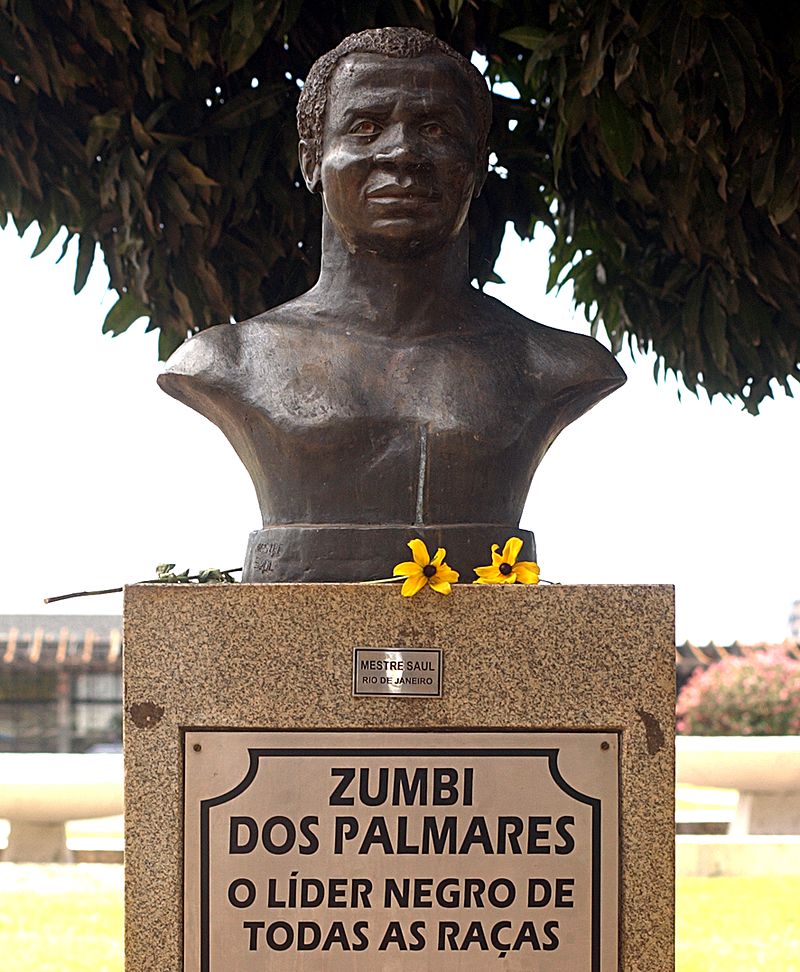
Zumbi (1655-1695) was the last leader of the Quilombo dos Palmares community. Likely descending from Angolan or Kongolese parents, Zumbi was born free in the Palmares community. His name may derive from Angola’s Kimbundu language, in which the word “nzambi” refers to “supreme being”; alternatively, “nzumbi” denotes “ancestral spirit.”1 “Zumbi” was, regardless, understood within an African history of a cult of ancestors, although it is unknown whether or not Zumbi functioned as a title more so than a name. He assumed power in 1680 following the death of his uncle, Ganga Zumba, and led an aggressive military retaliation against the combatant Portuguese.2 Although Palmares was suppressed by the colonial power in 1674, Zumbi fought on into the following year. He was killed by the Portuguese in 1695, his body brought back to the government council in Porto Calvo to verify his death and his head subsequently to Recife.3
“Zumbi embodies the strongest resistance to the slave-based colonial regime, and, consequently, the struggle for economic and political justice today. The last leader of Palmares has enjoyed an apotheosis as an ethnic hero. The term ‘apotheosis’ is not simply metaphorical here. More than a secular hero, Zumbi is viewed as an ancestor, antecedent in what the outsider might see as a fictive lineage…Since the establishment of 20 November as National Black Consciousness Day in 1978, popular discourse has increasingly treated Zumbi not only as the premier Afro-Brazilian hero but also as the exemplar of antiracist and anticolonial dogma and praxis”
Robert Nelson Anderson, “The Quilombo of Palmares: A New Overview of a Maroon State in Seventeenth-Century Brazil,” Journal of Latin American Studies 28, no. 3 (1996): 545-546.
Since the late seventeenth century, Zumbi has become a cult figure in Brazil as an emblem of resistance to colonial authority. For this reason, his name will be embedded in the very structure of this archive. This archive necessarily draws on violent colonial sources and accounts of those who wanted to destroy Palmares. In order to recognize the tradition of Quilombo dos Palmares and visually index the colonial gaze, posts will be organized in a “Z” pattern in reference to Zumbi and the many nameless Palmarians who sought freedom.
Footnotes
- Glenn Alan Cheney, Quilombo dos Palmares: Brazil’s Lost Nation of Fugitive Slaves (Hanover: New London Librarium, 2014), 114.
- Robert Nelson Anderson, “The Quilombo of Palmares: A New Overview of a Maroon State in Seventeenth-Century Brazil,” Journal of Latin American Studies 28, no. 3 (1996): 563.
- Cheney, Quilombo dos Palmares, 199.
Image: https://commons.wikimedia.org/wiki/File:Zumbidospalmares.jpg
 QUILOMBO DOS PALMARES AND SEVENTEENTH-CENTURY BRAZIL
